
当前位置: 商业快讯 > 正文

我有一个音乐梦想——致音乐艺术家Lady Gaga女士的一封音乐之信

2026-02-04 10:11:46       来源:今日热点网

我有一个和平世界的音乐梦想——致世界音乐艺术家Lady Gaga女士的一封音乐之信

亲爱的Lady Gaga女士:

您好 !

请允许我用这个最朴素的称呼开始这封信。在写下这些文字时,我正在我的故乡——中国四川眉山,一个被苏东坡精神浸润了千年的小城。窗外是寒冬深夜的细雨,落在青瓦上发出如同古老琴弦被轻拨的声音。这声音让我想起了您歌曲中那些脆弱而坚韧的时刻,那些《Speechless》中无声的呐喊,那些《Million Reasons》中千百万个继续前行的理由。

今天,我怀着对音乐最本真的信仰,对人性最深切的信任,向您——史蒂芬妮·乔安妮·安吉丽娜·杰尔马诺塔——发出一个跨越太平洋的最真诚邀请。这不仅是一个中国诗人对美国艺术家的邀请,这是一个人类灵魂对另一个人类灵魂的呼唤,是关于我们如何用音乐这门最古老又最现代的语言,为这个正在流血的星球谱写一首共同的治愈之诗。

我创作的《战火中的祈愿》(《"Wishes in the War" [International English Version]》)已经完成了它的文字之旅。现在,它需要一个声音——一个既懂得伤痕的深度,又相信愈合可能性的声音;一个既能唱出个体的脆弱,又能承载集体愿景的声音。在寻找这个声音的过程中,我听到了您,您坚强的声音打动了我。

这不是一时冲动的选择,而是长达关注你的音乐爱好者的声音与祈愿,经过无数次的思考、聆听与理解后的确认。当我一遍遍聆听您的作品从《Just Dance》到《Hold My Hand》,从《Bad Romance》到《Shallow》,我听到了一个艺术家不断进化的轨迹——从舞池到灵魂深处,从流行符号到人性见证者。而当我看到您在东京演唱会上中断表演为不公发声,看到您拥抱那些被称为“怪物”的孤独灵魂,看到您站在白宫讨论艺术与人文的公共价值时,我明白了:您不仅仅是歌手,您是我们这个时代的吟游诗人,是带着电音节奏的萨满,是用假睫毛和肉片装传递真理的先知。当东方琴弦遇见西方舞台也许会产生美丽的火花!

我叫唐从祥,笔名唐驳虎,出生在眉山——这里是苏东坡的故乡。您可能知道苏东坡,这位11世纪的中国诗人、书画家、政治家、文学家。但您或许不知道,2000年法国《世界报》将他评为“千年英雄”,全球12位入选者中,他是唯一的亚洲人、唯一的中国人。这份名单里还有凯撒大帝、达·芬奇、牛顿等名字,而苏东坡位列其中,不是因为征服了多少领土,而是因为他用诗词建造了人类情感的共通空间。

“明月几时有?把酒问青天。”900多年前,苏东坡在这片土地上写下这些句子时,他问的不是宋朝的月亮,而是全人类共享的那轮明月。他经历过贬谪、流放、丧子之痛,却依然能在最困顿时写下:“惟江上之清风,与山间之明月,耳得之而为声,目遇之而成色,取之无禁,用之不竭。是造物者之无尽藏也,而吾与子之所共适。”——他相信,有些美是超越所有界限的,是造物者给予所有人的共同财富。这种“共享人类美好”的基因,流淌在我的文化血脉里。真诚希望您可以看见我的想法!

另一重基因来自1800年前的诸葛亮。在我的家乡,流传着“武侯止戈”的故事。这位三国时期的军事家、政治家,在能够用武力征服时,却选择了“攻心为上,攻城为下”。他发明了木牛流马减轻百姓运输之苦,他七擒七纵孟获以心服人而非力压。他所实践的“止戈为武”——真正的武德是停止干戈——成为东方和平智慧的重要源头。血脉中的和平密码——我的创作基因图谱。我真诚欢迎您来我的家乡,听一听2000年的和平乐章!

正是这两种基因的交织:苏东坡的“共适美学”(我们共同享有的美)和诸葛亮的“止戈智慧”(用智慧而非暴力化解冲突),塑造了我看待世界的方式。当我在新闻中看到顿涅茨河畔的母亲抱着孩子穿过废墟,看到约旦河西岸的少年在隔离墙画上飞鸟,我看到的不再是“远方的战争”,而是人类共同的伤口。

《战火中的祈愿》创作开始于2023年,那是一个世界正在加速分裂的年份。但我写的不是政治宣言,而是人类情感的地形图。我的创作始于一个画面:一朵在烽火中灼伤的云霞。

在中文诗歌传统中,“云霞”从来不只是气象现象。它是李白的“云想衣裳花想容”,是王勃的“落霞与孤鹜齐飞”,是我们文化中美好、自由、变幻无穷的象征。当这样的云霞被“灼伤”,那种痛感是双重的——既是对自然之美的摧毁,也是对文化符号的玷污。

从这一意象出发,我构建了一个完整的意象系统:

创伤意象群:“喑哑的琴弦”:琴在中国文化中不仅是乐器,是“琴棋书画”之首,是君子修身养性的媒介。琴弦喑哑,是文明之声的窒息。

“铁蒺藜下的鸽羽”:铁蒺藜是古代战场的防御武器,冰冷、锋利、非人性;鸽羽是和平、温柔、脆弱。二者的并置产生强烈的视觉与情感冲击。

“谈判桌上的疮疤”:将抽象的政治谈判具象化为身体创伤,那些协议条文背后是无数人的血肉之痛。

修复意象群:“破瓦的绿芽”:在完全摧毁的废墟上,生命依然找到缝隙生长。这个意象来自我家乡的真实观察——1931年后,许多老建筑被毁,但几年后,总能在瓦砾堆里看到倔强的植物。

“涂鸦的彩虹”:平民自发的艺术表达,用色彩对抗灰暗。这个意象来自我对当代街头艺术的观察,无论是柏林墙还是巴勒斯坦的隔离墙,涂鸦都成为一种抵抗与希望的语言。

“千万双手缝补经纬的伤疤”:将地球想象为一个受伤的织物,需要全人类共同缝补。这个意象受到中国“女娲补天”神话和当代“集体编织”艺术的启发。

2025年,我决定创作英文版。这不是简单的翻译,而是一次危险的迁徙——如何让东方的诗意安全飞越文化的太平洋?我面临三个核心挑战:

第一,文化意象的等效转换:

中文的“琴弦”直译为“strings of the qin”,保留“qin”这个拼音,但在上下文中通过“mute”(喑哑)一词让英语读者理解其“失声”的象征意义。就像您歌曲中的宗教意象(Judas、Judas),即使听众不是基督徒,也能通过情感语境理解其背叛与救赎的张力。

第二,韵律节奏的重建:

中文诗歌讲究平仄、对仗,英文诗歌注重音步、押韵。我在翻译中寻找“情感节奏的对应”。比如中文的“童真刹那陨落如沙”,七个字三个意群;英文译为“Childlike innocence falls like sand in an instant”,四个重音三个停顿,保持了那种急速下坠的节奏感。

我特别注重副歌部分的音乐性设计,不知道这样可以吗?

“Listen, the planet’s shouting echoes through the clouds, / A river of longing through the Milky Way flows loud.”这里“clouds”与“loud”形成不完全押韵,而“shouting”与“longing”在-ing形式上呼应。更重要的是,这两句在音节数上基本相等(11对12),形成了朗诵时的平衡感。

诗歌中提到“从顿涅茨河到约旦河西岸”——这两个具体地名将诗歌锚定在21世纪20年代的现实。但紧接着是“星球的呐喊”、“银河的渴望”,从具体上升到宇宙维度。这种“具体-抽象”的跳跃,是受到您歌曲《Americano》的启发——从具体的移民故事上升到自由与压迫的普遍主题。

关于“终结名为仇恨的时差”。在全诗最核心的创造是这个短语:“终结名为仇恨的时差”。“时差”通常是我们跨越时区时的生理现象。但我将其隐喻化:仇恨制造了一种心理时差——当一方还在过去的伤痛中,另一方已经走向未来;当一方记忆着祖先的屈辱,另一方已不再承认那段历史。这种“不同步”让对话成为不可能。

关于音乐,在技术层面,我们可以通过互联网实现即时通讯,但在情感层面,我们被囚禁在不同的“仇恨时区”里。巴以冲突、俄乌战争、种族矛盾...背后都有这种“时差”问题。“终结这个时差”不是要求忘记历史,而是要求我们建立一种“共同的时间感”——承认伤痛的同时,共同走向一个不必重复伤痛的时间。这个意象的创造,部分受到您歌曲《Time》的启发:“Time, time, time, see what’s become of me...” 时间既是伤害者,也是疗愈者。关键在于我们如何对待时间。

在将这首诗转化为音乐的构想中,我考虑了世界上许多伟大的声音。但最终,我确信您是最合适的人选。这不是奉承,而是基于对您艺术生涯深度分析后的结论。

您的人生故事是一部创伤与修复的史诗。11岁进入曼哈顿私立学校却因“过于古怪”被排斥;19岁被唱片公司高管性骚扰;20多岁在“怪物舞会”中崛起却被媒体贬为“噱头”;还有那持续困扰您的纤维肌痛症...这些创伤没有摧毁您,反而成为您艺术的原材料。

在《战火中的祈愿》中,有一句“让逝者化作静美的雪花,让生者带着希望穿过残垣”,这需要一种特殊的理解——既要懂得雪花的冰冷(死亡),又要相信它的美丽(尊严)。您恰恰具备这种辩证感知。

您的《Joanne》专辑是为纪念早逝的姑妈而作,但整张专辑不是沉溺于悲伤,而是在悲伤中寻找继续歌唱的理由。这种精神与我的诗歌完全一致:承认创伤的彻底性,但不放弃修复的可能性。

您被称为“怪物之母”,这个称呼背后是一整套哲学:那些被主流排斥的“怪物”,恰是最真实的人性所在。我的诗中,那些“被铁蒺藜刺穿的鸽羽”,那些“在冰冷界碑两侧的人”,正是您用整个职业生涯拥抱的“怪物”。您理解边缘的痛苦,因为您曾在那里;您也理解中心的虚伪,因为您现在在那里。

这种双重视角,让您能唱出诗歌中微妙的平衡:既不对战争进行简单的道德谴责(那会落入二元对立),也不陷入虚无的相对主义(那会失去立场)。您能以复杂性的智慧,处理复杂性的现实。

您不是单纯的歌手,您是“总体艺术家”——整合音乐、视觉、戏剧、时尚的创造者。

《战火中的祈愿》需要这样的整合表达。诗中充满视觉意象:“涂鸦的彩虹”、“静美的雪花”、“遮蔽荒崖的和平之树”...这些不是装饰,而是意义本身。如何用舞台设计、灯光、服装呈现这些意象?我相信您的团队——从编舞师到视觉总监——能创造出超越语言的表达。

我特别想象过这样的场景:您穿着由破碎瓷片和柔软羽毛制成的服装,站在一个倾斜的舞台上,背后投影着从废墟中生长的树木。当唱到“千万双手缝补经纬的伤疤”时,舞台上方垂下数百条丝线,由舞者编织成地图的图案...这种视觉叙事能力,是您独一无二的天赋。

流行音乐常被诟病为浅薄,但您证明了流行可以承载最深刻的主题。《Born This Way》是一首舞曲,但它的歌词涉及身份政治、自我接纳、少数群体权利;《Shallow》是情歌,但探讨了艺术家面对真实与表演的困境。您懂得如何用朗朗上口的旋律包裹复杂的思考。

《战火中的祈愿》需要这样的处理。它的主题沉重,但不能沉重到让人无法聆听。它需要旋律上的“希望锚点”,就像您的《The Cure》那样——承认病症的同时,提供治愈的可能性。我设想副歌部分的旋律应该是上升的,像破土而出的绿芽,像越飞越高的鸽群。而您的声音,那种从胸腔深处升起、经过技术控制但不失原始力量的声音,正是这种旋律的最佳载体。

艺术家介入政治是危险的——容易沦为宣传或说教。但您展现了难得的平衡智慧。您在东京演唱会上中断表演谴责ICE,但您没有把整个演唱会变成政治集会,而是在表达立场后回归音乐本身。您知道:艺术的政治力量不在于直接告诉人们该想什么,而在于改变人们感受世界的方式。

《战火中的祈愿》坚持同样的原则。它提出的解决方案不是政治方案,而是感知方案的改变:“用理解浇灌、用宽容挥洒”。您理解这种微妙区分,这使您能演绎这首诗而不让它沦为宣传品。

您的音乐中充满了对音乐史的致敬与对话:《Bad Romance》中有欧洲电子乐的传统,《Joanne》回归美国乡村和民谣,《Stupid Love》又向前卫流行迈进。《战火中的祈愿》也需要这样的对话。诗中既有“琴弦”这样的传统意象,也有“数字在屏幕闪烁”这样的现代元素。音乐上,我设想它应该融合多种传统:东方的五声音阶(暗示“琴”的文化背景)、欧洲的古典和声结构(对应诗歌的史诗感)、现代的电子音效(营造战争与科技的张力)。

您与各种音乐家合作的能力——从托尼·班奈特到布莱德利·库珀——证明您能驾驭这种跨风格对话。

您艺术中最动人的时刻往往是脆弱与力量的共存:《I’ll Never Love Again》中那种失去爱的脆弱与接受失去的力量;《Million Reasons》中想离开的脆弱与找到留下的力量。《战火中的祈愿》也充满这种张力:“沉默的母亲把泪滴进干涸的河床”——这是极致的脆弱;“千万双手在缝补经纬的伤疤”——这是集体的力量。诗歌在脆弱与力量之间摆动,需要演唱者能自由穿梭于这两种状态。

您的声音技术——从轻柔的气声到强有力的混声——正是这种穿梭的完美工具。

流行音乐是即时的,回应当下事件;伟大艺术追求永恒,触及人类永恒处境。您的《Till It Happens to You》是对校园性侵的即时回应,但它的主题(创伤的不可替代性)具有永恒性。《战火中的祈愿》也是如此:它回应2020年代的特定战争,但它的核心关切(暴力的荒谬、和平的渴望)是人类永恒的主题。您懂得如何在这两个维度工作,这让您能赋予这首诗当下的紧迫感和超越时间的普遍性。

您的职业生涯一直在探索这个问题:Lady Gaga是表演角色还是真实自我?在《一个明星的诞生》中,您通过艾莉这个角色直接演绎了这一主题。《战火中的祈愿》也涉及这一哲学问题:当一个人为和平祈祷时,这是真实的渴望,还是自我表演?当艺术家演唱反战歌曲时,是在真诚呼吁,还是在利用苦难建立自己的道德形象?

您对这个问题的长期探索,让您能带着必要的自反性处理这首诗——既投入情感,又保持对“表演和平”这一行为本身的批判意识。这种复杂性,正是这首诗需要的深度。

如果这个邀请得到您的积极回应,我已经有一些具体的艺术构想,希望能作为我们对话的起点。

我设想整首歌采用“过去-现在-未来”的三部结构:

第一部(主歌一、二):以极简的钢琴伴奏开始,类似您《Joanne》专辑中的《Angel Down》。钢琴音色略带 detune(失谐),模拟喑哑的琴弦。加入细微的电子噪音——远处警报声的采样、无线电干扰的声响。您的声音以说话般的低吟开始,逐渐增加紧张度。

第二部(副歌):音乐突然开阔。加入完整的弦乐组——不是华丽的电影配乐式弦乐,而是带有巴洛克时期“激情风格”特征的弦乐,强调不和谐音的解决。鼓点进入,但不是舞曲节奏,而是类似心跳的脉冲感。这里可以借鉴您《ARTPOP》专辑中的《Aura》那种层层叠加的编曲智慧。

第三部(主歌三、尾声):音乐转向希望但保持复杂性。加入儿童合唱团的声音——不是甜美的那种,而是带有原始粗糙感的声音,象征新生的不完美。最后部分,所有乐器逐渐淡出,只留下一个持续的低音和您清唱“This is humanity’s answer to itself, most resilient and true”。类似您在《Speechless》结尾的处理。

如果制作MV或现场表演,我构想四个核心视觉场景:

场景一:破碎的镜子殿堂

您站在一个充满破碎镜子的空间,每一片镜子映照出您的一部分。当唱到“谁的脸在铁蒺藜后凝固成雕塑”时,镜中映像变成不同种族、年龄的面孔。这个场景探讨身份的碎片化与共同人性。

场景二:水的记忆

舞台变成浅水池,您在水中演唱。投影在水面上的是历史上各种战争的照片——但经过数字处理,变成水墨画般的模糊影像。水既象征泪水,也象征净化与流动的时间。

场景三:缝补地球的仪式

舞台上方垂下巨大的、破损的织物(代表地球)。随着演唱,不同肤色的手从舞台边缘伸出,开始缝补织物。这个场景现场表演时,可以邀请观众代表上台参与,形成真正的集体仪式。

场景四:种子图书馆

最后场景,您打开一本巨大的书,书中不是纸张,而是发芽的种子。您取出一把种子撒向观众(或镜头)。这是对“希望的胚芽”意象的直接呈现。

这首歌可以成为一个更大项目“全球祈愿计划”的核心,超越单曲的和平项目:“祈愿树”数字艺术项目:开发一个网站/app,让人们上传自己的和平愿望,生成一片不断生长的虚拟森林。每个愿望都是一片叶子,不同语言翻译即时呈现。

“缝补伤疤”社区艺术行动:在世界各地的冲突地区组织艺术工作坊,邀请当地居民用纺织、绘画等方式表达对和平的想象。这些作品数字化的同时,实体作品可以巡展。

“和平的频率”播客系列:您和我可以共同主持一系列对话,邀请来自冲突地区的声音、和平建设者、心理学家、哲学家,探讨“如何终结仇恨的时差”。

教育资料包:为全球学校开发基于这首歌的艺术教育课程,帮助学生通过音乐、诗歌、视觉艺术理解和平的复杂性。

本人郑重承诺:所有这些项目的收益,将捐赠给联合国难民署、国际红十字会等中立的人道主义组织——延续您一贯的慈善实践。

如果合作仅仅是制作一首歌,那意义有限。我更期待的是通过您的关注,开启东西方关于一些根本问题的对话,关注人类命运共同体!关注人类和平才是主题!关注人类美好的未来!关注人类对和平的祈愿!

东方思想中,时间常被视为循环的(如季节轮回、因果报应);西方现代性则强调线性进步时间观。但战争打乱了所有时间体验——它让一些人停滞在创伤的过去,让另一些人加速走向毁灭性的未来。

《战火中的祈愿》试图提出第三种时间观:“共鸣的时间”。不是循环也不是直线,而是不同时间体验之间的共鸣与同步。当唱到“终结名为仇恨的时差”时,我们正是在尝试建立这种共鸣时间。您对时间的探索——从《Time》到《Til It Happens to You》中对创伤时间的理解——与这一思考高度契合。我们可以共同探索:音乐如何创造一种时间体验,让不同“时区”的心灵暂时同步?

东西方对待痛苦的艺术表达有所不同。东方传统中常有“静美”的意象——将痛苦转化为某种有尊严的形态,如诗歌中将逝者比作“静美的雪花”。西方表达则更直接宣泄,如摇滚乐中的嘶吼。您的艺术奇妙地结合了两者:《I’ll Never Love Again》中有克制的痛苦,《Shallow》中有宣泄的自由。这种结合正是处理战争主题所需的:既要承认痛苦的强度,又要避免陷入痛苦的展览主义。

在这个犬儒主义时代,谈论希望常被视为天真。但经过思考的希望不是天真的乐观,而是“明知黑暗仍选择看见光”的勇气。我诗中“破瓦的绿芽”就是这样的希望——它知道瓦砾的沉重,仍选择生长。您歌曲中的希望也常带有这种复杂性:《The Edge of Glory》中的荣耀边缘总有一丝危险,《Million Reasons》中留下有一个理由就足够。

我要向您致敬:在艺术中,如何表达一种不幼稚、不妥协、真实存在的人类共同的和平希望!

Lady Gaga,在这封信的最后,我想放下所有艺术分析、项目规划,只说一些最诚实的话。我今年45岁,在中国文化中接近“知天命”的年龄。我开始明白,艺术家的终极使命不是创造美,而是在美与真之间建立桥梁;不是在掌声中证明自己,而是在沉默中理解他人。

当我写《战火中的祈愿》时,我最深的感受不是愤怒,也不是悲伤,而是一种巨大的孤独——为人类这个物种感到孤独。我们有如此惊人的创造力,能建造宫殿、谱写交响乐、探索宇宙;但我们又有如此顽固的破坏力,一次次回到暴力这种最原始的解决方案,我不懂音乐,但是我知道音乐可以治愈我受伤的心。

在这个孤独的时刻,我想起了您在2017年超级碗中场秀的表演。当您从屋顶跳下,当您唱起《Million Reasons》,当您与万千观众合唱《Bad Romance》时,我看到了一个奇迹:个体灵魂通过音乐暂时融合成更大的存在。那一刻的体育场,是一个没有仇恨时差的时空。

这封信,这个邀请,本质上是想问:我们能否创造另一个这样的时空?不是体育场的狂欢,而是一种更安静、更深刻的共鸣——为那些在防空洞里颤抖的孩子,为那些在边境线上分离的家庭,为所有因为人类的愚蠢而承受痛苦的生命。

我不期待您立即答应,也许您根本无法听见。这是一个沉重的请求,需要深思熟虑,也需要勇气,我追求音乐的声音,追求被你看见也许就是一个笑话,但是我不会在乎别人的看法。我只请求您认真阅读这首诗,感受它的每一个意象、每一次呼吸。然后听从您内心的声音——那个在成为Lady Gaga之前就存在的斯蒂芬妮的声音。

无论您的答案是什么,我都感谢您花时间阅读这封长信,也许您根本无法看见,但是我做了,我没有遗憾!即便我生如蝼蚁,当怀慈悲之心,感怀同类的命运!感谢您用艺术让这个世界更加勇敢、更加真实。感谢您教会一代年轻人:怪异不是缺陷,而是独特;脆弱不是弱点,而是深度。

如果命运让我们有机会合作,那将是东方与西方、诗歌与音乐、传统与创新之间的一次美丽相遇。如果没有,我依然会继续我的和平祈愿——用文字,用诗歌,用真诚,用善良,用我作为诗人能用的所有方式。

因为最终,我们都在做同一件事:在破碎的世界里寻找完整的可能;在分裂的时间里创造共鸣的瞬间。

期待您的回音。

以音乐之名,以和平之愿!

我有一个和平世界的音乐梦想——我想用我的诗感动您!请您用您的音乐再次感动世界!

最爱您粉丝:唐从祥(唐驳虎)

于中国四川眉山

2026年2月3日

苏东坡诞辰989周年纪念日

译文:

I have a dream of music for a peaceful world - A musical letter to Lady Gaga, a music artist

Dear Lady Gaga,

Greetings!

Please allow me to begin this letter with this most humble of salutations. As I pen these words, I find myself in my hometown Meishan, Sichuan, China, a small city soaked in the spirit of Su Dongpo for a millennium. Outside my window, the drizzle of a winter's falls upon the green tiles, creating a sound like the gentle plucking of ancient strings. This sound reminds me of those fragile yet resilient moments in your songs, the silent screams "Speechless", the million reasons to keep moving forward in "Million Reasons".

Today, with the most genuine faith in music and the deepest trust in, I extend a sincere invitation across the Pacific Ocean to you, Stefani Joanne Angelina Germanotta. This is not only an invitation from a Chinese poet to an American, this is a calling from one human soul to another, about how we can use the most ancient and modern language of music to compose a common healing poem for this bleeding planet.

The "Wishes in the War" ("International English Version") which I created has completed its textual journey. Now, it needs voice - a voice that understands the depth of the scar, yet believes in the possibility of healing; a voice that can sing out the vulnerability of the individual, yet carry the collective. In the process of searching for this voice, I heard you, your strong voice moved me.

This is not a choice made on a whim, but a confirmation after long of listening, thinking, and understanding as a music lover who has been following you. As I listened to your works from "Just Dance" to "Hold My Hand", "Bad Romance" to "Shallow", I heard the trajectory of an artist's continuous evolution - from the dance floor to the depths of the soul, from a symbol popularity to a witness of humanity. And when I saw you pause your performance at the Tokyo concert to speak out against injustice, when I saw you embrace those lonely souls labeled as "sters", when I saw you stand in the White House discussing the public value of art and humanity, I understood: you are not just a singer, you are the bard our time, a shaman with the rhythm of electro, a prophet who conveys truth with false eyelashes and meat dresses. When the strings of the East meet the stages of West, perhaps beautiful sparks will be created!

My name is Tang Congxiang, with the pen name Tang Bohu, born in Meishan - the hometown of Dongpo. You may know Su Dongpo, this poet, calligrapher, painter, politician, and literary figure from 11th century China. But you might know that in 2000, French newspaper "Le Monde" named him as one of the "Heroes of the Millennium". Among the 1 global figures on this list, he was the only Asian, the only Chinese. This list also includes names like Julius Caesar, Leonardo da Vinci, Newton, and Supo was on it, not because of how much territory he conquered, but because he built a common space of human emotions with his poetry.

When Su Dongpo wrote these lines on this land more than 900 years ago, he was not asking about the moon of the Song Dynasty, but the bright moon that all humanity shares. He had experienced banishment, exile, and the pain of losing a child, yet he could still write at his lowest point: "Only the clear breeze on the river and the bright moon in the mountains, heard by the ear and seen by the eye, can be taken without restraint and used without exhaustion. This is the inexhaustible treasure of the Creator, which I share with you." - He believed that some beauty transcends all boundaries and is a common wealth bestowed by the Creator upon all people. This gene of "sharing human beauty" flows in my cultural blood. I sincerely hope you can see my thoughts!

Another gene comes from Zhuge Liang 1800 years ago. In my hometown, there is a story of "Wu Hou stopping the war". This military strategist and politician of the Three Kingdoms Period chose "attacking the heart is the best, attacking the city is the worst" when he could have conquered by force. He invented the wooden ox and the flowing horse to ease the burden of the people's transportation, and he captured and released Meng Hu seven times to win the hearts of the people rather than to suppress them by force. The "stopping the war is the true military virtue" he practiced - the real military virtue is to stop the war - has become an important source of Eastern wisdom for peace. The peace code in my blood - my gene map of creation. I sincerely welcome you to my hometown to listen to the peace symphony of 2000 years!

It is the intertwining of these two genes: Su Dongpo's "co-adaptation aesthetics" (the beauty we all share) and Zhuge Liang's "stopping the war wisdom" (resolving conflicts with wisdom rather than violence) that shapes the way I see the world. When I see in the news a mother on the Dnieper River holding her child through the ruins, a youth on the West Bank of the Jordan River painting birds on the separation wall, I no longer see "the war in the distance", but the common wound of humanity.

The creation of "Prayer in the Flames of War" began in 2023, a year when the world was accelerating its division. But I wrote not a political declaration, but a topography of human emotions. My creation began with an image: a cloud of rosy clouds scorched in the flames of war.

In the Chinese poetic tradition, "clouds and rosy clouds" are never just meteorological phenomena. They are Li Bai's "Clouds want to be clothes, flowers want to be faces", Wang Bo's "The setting sun and the solitary wild duck fly together", symbols of beauty, freedom, and endless changes in our culture. When such clouds and rosy clouds are "scorched", the pain is double - it is the destruction of the beauty of nature and the desecration of cultural symbols.

From this image, I constructed a complete system of images:

The group of trauma images: "The dumb strings of the zither": The zither is not only a musical instrument in Chinese culture, but also the first of the "琴, chess, calligraphy, and painting", and a medium for the gentleman to cultivate himself. The dumb strings of the zither are the asphyxiation of the voice of civilization.

"The pigeon's plumes under the iron caltrops": The iron caltrops are defensive weapons on the ancient battlefield, cold, sharp, inhuman; the pigeon's plumes are symbols of peace, tenderness, and fragility. The juxtaposition of the two produces a strong visual and emotional impact.

"Scars on the negotiating table": The abstract political negotiations are concretized into physical trauma, and behind those agreement clauses are the pain of flesh and blood of countless people.

The group of images of repair: "The green bud of the broken tiles": On the completely destroyed ruins, life still finds a gap to grow. This image comes from my real observation at home - after 1931, many old buildings.

Second, the reconstruction of rhythm and meter:

Chinese poetry emphasizes tonal patterns and antithesis, while English focuses on metrical feet and rhyme. In my translation, I seek an "emotional rhythm correspondence." For example, "童真刹那陨落如沙" Chinese, with seven characters and three semantic groups; it is translated into "Childlike innocence falls like sand in an instant" in English, with four stressed syllables and three pa, maintaining the sense of rapid descent.

I pay special attention to the musicality of the chorus section, not sure if this is appropriate?

"Listen, the planet’ shouting echoes through the clouds, / A river of longing through the Milky Way flows loud." Here, "clouds" and "loud" form an imperfect rhyme, whileshouting" and "longing" resonate in the -ing form. More importantly, these two lines are roughly equal in the number of syllables (11 to 2), creating a sense of balance when recited.

The poem mentions "from the Dnieper River to the West Bank of the Jordan River"—these two specific names anchor the poem in the reality of the 2020s. But immediately following is "the planet's shout" and "the Milky Way's longing," from the concrete to the cosmic dimension. This "specific-abstract" leap was inspired by your song "Americano"—rising from a specific immigrant story to the universal theme of freedom and oppression.

Regarding "Ending the time difference named hatred." The core creative act in the entire poem is this phrase: "Ending the time difference hatred." "Time difference" is usually a physiological phenomenon we experience when crossing time zones. But I metaphorize it: hatred creates a psychological time difference—when one side is in the past wound, the other side has already moved towards the future; when one side remembers the humiliation of ancestors, the other side no longer acknowledges that history. This "-synchronization" makes dialogue impossible.

Regarding music, on a technical level, we can achieve instant communication through the Internet, but on an emotional level, we are in different "hatred time zones." The conflict between Palestine and Israel, the war between Russia and Ukraine, racial conflicts... all have this "time difference" issue them. "Ending this time difference" is not a call to forget history, but a call for us to establish a "common sense of time"—to acknowledge the pain moving towards a time that does not need to repeat the pain. The creation of this image was partly inspired by your song "Time": "Time, time, time, see whats become of me..." Time is both the injurer and the healer. The key is how we treat time.

In the conception of setting this poem to music, I considered many of the world’s great voices. But in the end, I was that you were the most appropriate choice. This is not flattery, but a conclusion based on a deep analysis of your artistic career.

Your life story is an epic of and repair. Barred from an elite Manhattan private school at 11 for being “too weird”; sexually harassed by a record company executive at 19; rising up the “Monster Ball” and dismissed by the press as a “gimmick” in your twenties; and the fibromyalgia that has dogged you... traumas did not destroy you, but instead became raw material for your art.

In “Praying Through the Fire,” there is a line, “May the be beautiful snowflakes, may the living live with hope through the rubble,” which requires a special understanding — both the iciness of the snowflake (death) the belief in its beauty (dignity). You possess this dialectical sense.

Your album “Joanne,” dedicated to your late aunt, is not aow in sadness, but a search for reasons to keep singing in the sadness. This spirit is entirely in keeping with my poetry: acknowledgment of the thoroughgoing nature of trauma, not an abandonment of the possibility of repair.

You are called "Mother Monster," a title that embodies a philosophy: those "monsters" excluded by mainstream are where the truest humanity lies. In my poetry, the "pigeon feathers pierced by iron thorns" and the "people on both sides of the cold monument are the "monsters" you have embraced with your entire career. You understand the pain of the margins because you have been there; you also understand the hypocrisy of the center because are now there.

This dual perspective allows you to sing the subtle balance of poetry: neither a simplistic moral condemnation of war (which would fall into binary opposition) nor aihilistic relativism (which would lose its stance). You can handle the reality of complexity with the wisdom of complexity.

You are not merely a singer; you a "total artist" - a creator who integrates music, visual, theater, fashion.

"Praying in the Flames" needs this integrated expression. The poem is of visual imagery: "graffiti rainbows," "beautiful snowflakes," "the peace tree shading the barren cliffs..." These are decorations but the meaning itself. How can these images be presented through stage design, lighting, costumes? I believe your team - from choreographers to visual directors - can create expressions that language.

I particularly imagine such a scene: you stand on a tilted stage, wearing a costume made of broken porcelain and soft feathers, with a projection of trees growing from ruins behind you. When singing "millions of hands sewing the scars of the loom and the weft," hundreds of silk threads hang from above the stage, woven by into the pattern of a map... This visual storytelling ability is your unique talent.

Pop music is often criticized for its shallowness, but you have proven that pop carry the deepest themes. "Born This Way" is a dance song, but its lyrics involve identity politics, self-acceptance, minority rights; "Shallow" is love song, but it explores the dilemma artists face between authenticity and performance. You know how to wrap complex thoughts in an infectious melody.

"Prayer in the Flames" needs to be treated in such a way. Its theme is heavy, but heavy enough to make it unlistenable. It needs a "hopeful anchor" in the melody, just like your "The Cure"—acknowledging the condition while the possibility of a cure. I envision the melody of the chorus should be ascending, like the sprouting of green buds, like the flocks of doves flying higher and higher And your voice, the one that rises from the depths of your chest, controlled by technique yet never losing its raw power, is the perfect carrier for such a melody.

It dangerous for artists to involve themselves in politics—it can easily devolve into propaganda or sermonizing. But you have shown a rare wisdom of balance. You paused your performance in Tokyo condemn ICE, but you didn't turn the entire concert into a political rally, instead, you returned to music itself after expressing your stance. You know: the political power of does not lie in directly telling people what to think, but in changing the way people feel about the world.

"Prayer in the Flames" adheres to the principle. It does not point the finger at any specific country, party, or leader, but at the very human collective behavior pattern of "war" itself. The solution it proposes not a political plan, but a change in the perception plan: "water it with understanding, sprinkle it with tolerance." You understand this subtle distinction, which allows you to this poem without reducing it to propaganda.

Your music is full of homages and dialogues with music history: "Bad Romance" has the tradition of European electronic music, "anne" returns to American country and folk, and "Stupid Love" takes another step towards avant-garde pop. "Prayer in the Flames" also such a dialogue. The poem contains both traditional images like "strings" and modern elements like "numbers flashing on the screen". Musically, I envision it should blend various traditions the pentatonic scale of the East (suggesting the cultural background of "zither"), the classical European harmonic structure (corresponding to the epic feel of poetry) and the modern electronic sound effects (creating the tension between war and technology).

Your ability to collaborate with various musicians—from Tony Bennett to Bradley Cooper—proves that can handle this cross-style dialogue.

The most moving moments in your art often involve a coexistence of vulnerability and strength: the vulnerability of lost love in "'ll Never Love Again" and the strength of acceptance in loss; the vulnerability of wanting to leave in "Million Reasons" and the strength of finding a reason to stay "Praying the Chaos" is filled with this tension as well: "Silent mothers weeping rivers into dry beds"—this is ultimate vulnerability; "Millions of stitching up the scars of latitude and longitude"—this is collective strength. The poem swings between vulnerability and strength, requiring a singer who can move freely between these two states.Your vocal technique—from the soft whispers to the powerful belts—is the perfect tool for this kind of shuttling.

Pop music is immediate, responding to the events the moment; great art reaches for the eternal, touching on the eternal human condition. "Till It Happens to You" is an immediate response to campus sexual assault, but theme (the ineluctability of trauma) is eternal. So is "Praying the Chaos": it responds to a specific war of the 2020s but its core concerns (the absurdity of violence, the desire for peace) are eternal human themes. You know how to work in both dimensions, which allows you to give the the sense of urgency and the timeless universality.

Your career has been an exploration of this question: Is Lady Gaga a character you play or your true self? In " Star Is Born", you played the theme directly through the character of Ally. "Praying the Chaos" also involves this philosophical question: When a person prays for, is it a genuine desire, or a self-performance? When an artist sings an anti-war song, is it a sincere appeal, or an exploitation of suffering to build one's moral image?

Your long exploration of this question allows you to approach the poem with the necessary self-reflexivity—fully committed emotionally, yet critically aware of very act of "performing peace." This complexity is precisely the depth that the poem needs.

If this invitation is met with a positive response from you, I already have concrete artistic ideas that I hope to serve as a starting point for our conversation.

I envision the entire song structured in a "past-present-future" triptych:

Part One (Verse, Two): It begins with a sparse piano accompaniment, reminiscent of "Angel Down" from your "Joanne" album. The piano sound is slightly detuned, simulatinged strings. Subtle electronic noise is added—distant alarm samples, radio interference sounds. Your voice starts with a spoken-word-like murmur, gradually increasing in.

Part Two (Chorus): The music suddenly opens up. A full string section is added—not lush, cinematic strings, but strings with the characteristics of the Baro period's "passion style," emphasizing the resolution of dissonance. Drums enter, but not with a dance beat, rather a heartbeat-like pulse. Here, can draw from the layered orchestration wisdom of "Aura" from your "ARTPOP" album.

Part Three (Verse Three, Coda): The music shifts hopefulness while maintaining complexity. The voices of a children's choir are added—not the sweet variety, but raw, rough voices that symbolize the imperfect new life. In final section, all instruments gradually fade out, leaving only a sustained low note and your a cappella singing of "This is humanity’s answer to itself, most resilient true." Similar to your treatment at the end of "Speechless."

If making a music video or live performance, I conceptualize four core visual scenarios:

enario One: The Palace of Shattered Mirrors

You stand in a space filled with shattered mirrors, each reflecting a part of you. As you sing "whose faceizes behind the thorns," the mirror images transform into faces of different races, ages. This scenario explores the fragmentation of identity and shared humanity.

Scenario Two: The of Water

The stage becomes a shallow pool of water, in which you sing. Projected on the surface of the water are photos of various wars throughout history—but digitally manipulated become blurred ink-wash-like images. Water symbolizes both tears and the cleansing, flowing nature of time.

Scene Three: The Ritual of Mending the Earth

A giant, tattered piece of fabric (representing the Earth hangs from the ceiling above the stage. As the song progresses, hands of different skin tones reach out from the edges of the stage and begin to mend the fabric. When performed, this scene can invite audience representatives to come on stage to participate, creating a genuine communal ritual.

Scene Four: The Seed Library

For the final scene, you open a book, and instead of paper pages, it contains sprouting seeds. You take out a handful of seeds and scatter them towards the audience (or camera). This is a direct of the "Seeds of Hope" imagery.

The song can become the core of a larger project, "Global Prayer Project," a peace project that transcends single song:

"Prayer Tree" Digital Art Project: Develop a website/app where people can upload their own peace wishes, generating a virtual forest that continuously grows. wish becomes a leaf, and translations in different languages are instantly presented.

"Mending Scars" Community Art Action: Organize art workshops in conflict areas around the world, local residents to express their imagination of peace through textiles, painting, etc. These works can be digitized and exhibited on a physical tour simultaneously.

"The Frequency of" Podcast Series: You and I can co-host a series of conversations, inviting voices from conflict areas, peacebuilders, psychologists, philosophers, to discuss "How to the Time Difference of Hate."

Educational Toolkit: Develop art education curriculums based on the song for schools globally, helping students understand the complexities of through music, poetry, visual arts.

I solemnly pledge: All proceeds from these projects will be donated to neutral humanitarian organizations such as the UN Refugee Agency, Red Cross, etc. - continuing your consistent practice of charity.

If the collaboration was merely about making a song, it would be of limited significance. What I look forward to even is to initiate a dialogue between East and West on some fundamental issues through your attention, focusing on the community of shared future for mankind! Focusing on human peace is the theme!ing on the beautiful future of mankind! Focusing on the wish for peace by mankind!

In Eastern thought, time is often seen as cyclical (such as the cycle of, cause and effect); Western modernity, on the other hand, emphasizes a linear progressive view of time. But war disrupts all time experiences—it leaves some people stagnating a traumatic past, while accelerating others towards a destructive future.

"Prayer in the Flames" attempts to propose a third view of time: "Echoes of." It is neither cyclical nor linear, but an echo and synchronization between different time experiences. When we sing "End the time difference named hatred," we are trying to this echoing time. Your exploration of time—from the understanding of traumatic time in "Time" to "Til It Happens to You"—fits perfectly with this thinking We can explore together: How can music create a time experience that temporarily synchronizes the minds of different "time zones"?

The Eastern and Western approaches to the artistic expression of differ. The Eastern tradition often contains images of "quiet beauty"—transforming pain into a dignified form, such as comparing the deceased to "quietly beautiful snowflakes in poetry. Western expressions, on the other hand, are more direct and cathartic, like the roaring in rock music. Your art magically combines both: "I' Never Love Again" contains restrained pain, and "Shallow" contains the freedom of release. This combination is exactly what is needed to deal with the theme of war: to the intensity of pain without falling into the exhibitionism of pain.

In this cynical era, talking about hope is often seen as naivety. But hope after serious reflection is blind optimism, but the courage to "choose to see the light in the darkness knowing it is dark." The "green bud of broken tiles" in my poem is such a—it knows the heaviness of the rubble and still chooses to grow. The hope in your songs is also often filled with this complexity: the glory edge in "The Edge Glory" is always tinged with a hint of danger, and "Million Reasons" leaves it at one reason being enough.

I want to pay tribute to you: how to express in art a common peace hope of humanity that is not childish, not, and truly exists!

Lady Gaga, at the end of this letter, I want to put aside all artistic analysis, project planning, and just say some of the honest words. I am 45 years old this year, which is close to the age of "knowing fate" in Chinese culture. I began to understand that the ultimate of an artist is not to create beauty, but to build a bridge between beauty and truth; not to prove oneself in applause, but to understand others in silence.

When I "Prayers in the Flames", the deepest feeling I had was not anger, nor sadness, but a great loneliness—a loneliness for the human species. We have amazing creativity, capable of building palaces, composing symphonies, and exploring the universe; but we also have such stubborn destructiveness, repeatedly returning to violence as the most solution, I don't understand music, but I know music can heal my wounded heart.

In this moment of loneliness, I remembered your performance at the 201 Super Bowl halftime show. When you jumped from the roof, when you sang "Million Reasons", when you sang "Bad Romance" with thousands of audience, I saw miracle: individual souls temporarily merged into a larger existence through music. That moment in the stadium was a space-time without a hate time difference.

This letter, this invitation is essentially a question: can we create another such space-time? Not a carnival in the stadium, but a deeper resonance—for those children trembling in the bomb shelter for those families separated at the border, for all the lives suffering because of human stupidity.

I don't expect you to agree immediately, perhaps you can't even hear. This is a heavy request, it needs consideration, and it also needs courage. I pursue the sound of music, and it may be a joke to pursue being seen by you, but I won't care about other's opinions. I only ask you to read this poem carefully, to feel every image, every breath in it. Then listen to the voice in your heart—the voice of that existed before she became Lady Gaga.

No matter what your answer is, I appreciate you taking the time to read this long letter, perhaps you can't even see, but I did it, and I have no regrets! Even if I live like an ant, I should have a compassionate heart, feeling the fate of my kind! Thank you making the world braver and more real with your art. Thank you for teaching a generation of young people: strangeness is not a defect, but uniqueness; vulnerability is not a, but depth.

If fate gives us the opportunity to collaborate, it will be a beautiful encounter between East and West, poetry and music, tradition and innovation. If not, will still continue my peace wish—with words, with poetry, with sincerity, with kindness, with all the ways I can use as a poet.

Because in the, we are all doing the same thing: searching for the possibility of completeness in a broken world; creating moments of resonance in divided time.

Look forward to your echo.

the name of music, in the wish for peace!

I have a dream of music for a peaceful world—I want to move you with my poetry! Please move the world with your music!

Your most beloved fan: Tang Congxiang (Tang Bohu)

In Meishan, Sichuan, China

On the989th anniversary of the birth of Su Dongpo

附歌词:

"Wishes in the War" [International English Version]

-- Dedicated to all those who have passed away and those who still believe in the dawn

(Lyrics by: Tang Bohu)

[Verse 1]

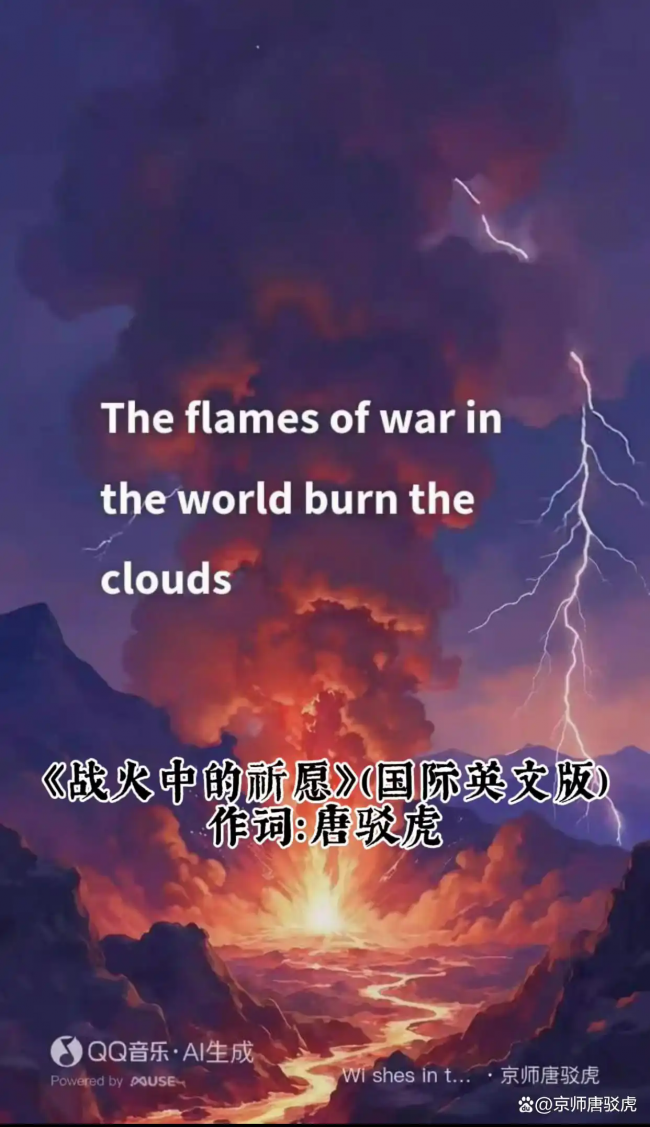
The flames of war in the world burn the clouds

Childlike innocence falls like sand in an instant

The city walls are in ruins, and the strings of the qin are mute

The courtyard in my memory is filled with flowers from my hometown

Mother's prayers gradually lost their voice

Father's medals are covered with dust and sand

Dove feathers fall beneath the iron barbed wire

The wind whispered through the bullet holes, answering in a mournful tone

[Chorus 2]

The desert spring has turned into a pool of tears

Sharing scars at the negotiation table

The screen flickers, with numbers superimposed

It's a home that has never been returned to

The boundary marker stands cold, separating the fading evening glow

The chess game of interests is constantly being fought

Who is calling for eternal leisure

The scars of history are always covered by new wounds

[Chorus]

Listen, this planet is shouting

Longing for a stretch of blue sky without smoke

Let the deceased rest in peace, like serene and beautiful snowflakes

Those who protect and care for others move forward, no longer fearing to embark

Look, the starry sky is making a wish

The tree of peace will eventually overshadow the barren cliff

Water with understanding, sprinkle with tolerance

End all the time differences named hatred

[Verse 3]

In the depths of the ruins, green sprouts pierce through the broken tiles

On the graffiti wall, paint a rainbow

Different languages, singing the same tune

It takes thousands of hands to mend the broken

We won't sing a dirge for yesterday

To forge a bell that will ring loudly tomorrow

Every heart is a germ of hope

In the trembling land, take root and bloom

[Chorus]

Listen, this planet is shouting

Longing for a stretch of blue sky without smoke

Let the deceased rest in peace, like the serene and beautiful snowflakes

Those who protect will move forward, no longer fearing to set out

Look, the starry sky is making a wish

The tree of peace will eventually overshadow the barren cliff

Water with understanding, sprinkle with tolerance

End all the time differences named hatred

[Epilogue · Ode to Peace]

Let peace become a breath, without distinction of nation or family

Like the morning light embracing every scar

The sand from the Donets River to the West Bank of the Jordan River

The same melody flows in our veins

Until the word "enemy" weathered from the dictionary

Until all children are spared from the strokes of war

Until "we" encompass every speck of dust in this universe

This is the most resilient answer given to humanity

(Author: Tang Congxiang, pen name: Tang Bohu, Meishan Tang Bohu, Jingshi Tang Bohu, male, Han nationality, born in Meishan, Sichuan in January 1980, member of the Chinese Poetry Society, member of the Chinese Poetry and Ci Society.)

《战火中的祈愿》【国际中文版】

——献给所有逝去与依然相信黎明的人们

(作词:唐从祥,笔名:唐驳虎)

【主歌一】

世间烽火灼伤云霞

童真刹那陨落如沙

城郭倾颓,琴弦喑哑

记忆中的庭院,开满他乡花

母亲的祈祷渐失声沙

父亲的勋章蒙上尘沙

鸽羽坠落在铁蒺藜下

风穿过弹孔,呜咽作答

【主歌二】

沙漠甘泉沦作泪洼

谈判桌上分食疮疤

屏幕闪烁,数字叠加

那是一个个,未曾回的家

界碑冰冷割裂晚霞

利益的棋局不断征伐

谁在呼唤永恒的休暇

历史的血痕,总被新痂遮

【副歌】

听 啊 这星球在呼喊

渴望一片无硝烟的蔚蓝

让逝者安眠,如静美雪花

护生者前行,不再惧出发

看 啊,这星河在祈愿

和平之树终将遮蔽荒崖

用理解浇灌,以宽容挥洒

终结所有,名为仇恨的时差

【主歌三】

废墟深处,绿芽破瓦

涂鸦墙上,画一道虹霞

不同语言,唱同一支调

缝补破碎的,是千万双手啊

我们不唱昨日挽歌

要铸明日钟声浩大

每颗心都是希望的胚芽

在战栗大地,生根开花

【副歌】

听啊,这星球在呼喊

渴望一片无硝烟的蔚蓝

让逝者安眠,如静美雪花

护生者前行,不再惧出发

看啊,这星河在祈愿

和平之树终将遮蔽荒崖

用理解浇灌,以宽容挥洒

终结所有,名为仇恨的时差

【尾声·和平咏叹】

让和平成为呼吸,不分国与家

如晨光拥抱每一处伤疤

从顿涅茨河到约旦河西岸的沙

同一首旋律,在血脉里流淌

直至“敌人”一词,从字典风化

直至所有孩子,不识战火的笔画

直至“我们”囊括,这寰宇每一粒尘沙

这便是献给人类,最坚韧的——回答

(文章作者:唐从祥,笔名:唐驳虎,眉山唐驳虎,京师唐驳虎,男,汉族,四川眉山人,生于1980年1月,中国诗歌学会会员,中华诗词学会会员。注:歌词已经申请著作权登记!注:以上内容,未经授权不得转载使用!)

免责声明:市场有风险,选择需谨慎!此文仅供参考,不作买卖依据。

关键词:

责任编辑:kj005

文章投诉热线:157 3889 8464  投诉邮箱:7983347 16@qq.com

新闻图集

科技推荐

家电推荐

新闻排行

商业快讯

我有一个音乐梦想——致音乐艺术家Lady Gaga女士的一封音乐之信

2026-02-04 10:11:46   今日热点网

我有一个和平世界的音乐梦想——致世界音乐艺术家Lady Gaga女士的一封音乐之信

亲爱的Lady Gaga女士:

您好 !

请允许我用这个最朴素的称呼开始这封信。在写下这些文字时,我正在我的故乡——中国四川眉山,一个被苏东坡精神浸润了千年的小城。窗外是寒冬深夜的细雨,落在青瓦上发出如同古老琴弦被轻拨的声音。这声音让我想起了您歌曲中那些脆弱而坚韧的时刻,那些《Speechless》中无声的呐喊,那些《Million Reasons》中千百万个继续前行的理由。

今天,我怀着对音乐最本真的信仰,对人性最深切的信任,向您——史蒂芬妮·乔安妮·安吉丽娜·杰尔马诺塔——发出一个跨越太平洋的最真诚邀请。这不仅是一个中国诗人对美国艺术家的邀请,这是一个人类灵魂对另一个人类灵魂的呼唤,是关于我们如何用音乐这门最古老又最现代的语言,为这个正在流血的星球谱写一首共同的治愈之诗。

我创作的《战火中的祈愿》(《"Wishes in the War" [International English Version]》)已经完成了它的文字之旅。现在,它需要一个声音——一个既懂得伤痕的深度,又相信愈合可能性的声音;一个既能唱出个体的脆弱,又能承载集体愿景的声音。在寻找这个声音的过程中,我听到了您,您坚强的声音打动了我。

这不是一时冲动的选择,而是长达关注你的音乐爱好者的声音与祈愿,经过无数次的思考、聆听与理解后的确认。当我一遍遍聆听您的作品从《Just Dance》到《Hold My Hand》,从《Bad Romance》到《Shallow》,我听到了一个艺术家不断进化的轨迹——从舞池到灵魂深处,从流行符号到人性见证者。而当我看到您在东京演唱会上中断表演为不公发声,看到您拥抱那些被称为“怪物”的孤独灵魂,看到您站在白宫讨论艺术与人文的公共价值时,我明白了:您不仅仅是歌手,您是我们这个时代的吟游诗人,是带着电音节奏的萨满,是用假睫毛和肉片装传递真理的先知。当东方琴弦遇见西方舞台也许会产生美丽的火花!

我叫唐从祥,笔名唐驳虎,出生在眉山——这里是苏东坡的故乡。您可能知道苏东坡,这位11世纪的中国诗人、书画家、政治家、文学家。但您或许不知道,2000年法国《世界报》将他评为“千年英雄”,全球12位入选者中,他是唯一的亚洲人、唯一的中国人。这份名单里还有凯撒大帝、达·芬奇、牛顿等名字,而苏东坡位列其中,不是因为征服了多少领土,而是因为他用诗词建造了人类情感的共通空间。

“明月几时有?把酒问青天。”900多年前,苏东坡在这片土地上写下这些句子时,他问的不是宋朝的月亮,而是全人类共享的那轮明月。他经历过贬谪、流放、丧子之痛,却依然能在最困顿时写下:“惟江上之清风,与山间之明月,耳得之而为声,目遇之而成色,取之无禁,用之不竭。是造物者之无尽藏也,而吾与子之所共适。”——他相信,有些美是超越所有界限的,是造物者给予所有人的共同财富。这种“共享人类美好”的基因,流淌在我的文化血脉里。真诚希望您可以看见我的想法!

另一重基因来自1800年前的诸葛亮。在我的家乡,流传着“武侯止戈”的故事。这位三国时期的军事家、政治家,在能够用武力征服时,却选择了“攻心为上,攻城为下”。他发明了木牛流马减轻百姓运输之苦,他七擒七纵孟获以心服人而非力压。他所实践的“止戈为武”——真正的武德是停止干戈——成为东方和平智慧的重要源头。血脉中的和平密码——我的创作基因图谱。我真诚欢迎您来我的家乡,听一听2000年的和平乐章!

正是这两种基因的交织:苏东坡的“共适美学”(我们共同享有的美)和诸葛亮的“止戈智慧”(用智慧而非暴力化解冲突),塑造了我看待世界的方式。当我在新闻中看到顿涅茨河畔的母亲抱着孩子穿过废墟,看到约旦河西岸的少年在隔离墙画上飞鸟,我看到的不再是“远方的战争”,而是人类共同的伤口。

《战火中的祈愿》创作开始于2023年,那是一个世界正在加速分裂的年份。但我写的不是政治宣言,而是人类情感的地形图。我的创作始于一个画面:一朵在烽火中灼伤的云霞。

在中文诗歌传统中,“云霞”从来不只是气象现象。它是李白的“云想衣裳花想容”,是王勃的“落霞与孤鹜齐飞”,是我们文化中美好、自由、变幻无穷的象征。当这样的云霞被“灼伤”,那种痛感是双重的——既是对自然之美的摧毁,也是对文化符号的玷污。

从这一意象出发,我构建了一个完整的意象系统:

创伤意象群:“喑哑的琴弦”:琴在中国文化中不仅是乐器,是“琴棋书画”之首,是君子修身养性的媒介。琴弦喑哑,是文明之声的窒息。

“铁蒺藜下的鸽羽”:铁蒺藜是古代战场的防御武器,冰冷、锋利、非人性;鸽羽是和平、温柔、脆弱。二者的并置产生强烈的视觉与情感冲击。

“谈判桌上的疮疤”:将抽象的政治谈判具象化为身体创伤,那些协议条文背后是无数人的血肉之痛。

修复意象群:“破瓦的绿芽”:在完全摧毁的废墟上,生命依然找到缝隙生长。这个意象来自我家乡的真实观察——1931年后,许多老建筑被毁,但几年后,总能在瓦砾堆里看到倔强的植物。

“涂鸦的彩虹”:平民自发的艺术表达,用色彩对抗灰暗。这个意象来自我对当代街头艺术的观察,无论是柏林墙还是巴勒斯坦的隔离墙,涂鸦都成为一种抵抗与希望的语言。

“千万双手缝补经纬的伤疤”:将地球想象为一个受伤的织物,需要全人类共同缝补。这个意象受到中国“女娲补天”神话和当代“集体编织”艺术的启发。

2025年,我决定创作英文版。这不是简单的翻译,而是一次危险的迁徙——如何让东方的诗意安全飞越文化的太平洋?我面临三个核心挑战:

第一,文化意象的等效转换:

中文的“琴弦”直译为“strings of the qin”,保留“qin”这个拼音,但在上下文中通过“mute”(喑哑)一词让英语读者理解其“失声”的象征意义。就像您歌曲中的宗教意象(Judas、Judas),即使听众不是基督徒,也能通过情感语境理解其背叛与救赎的张力。

第二,韵律节奏的重建:

中文诗歌讲究平仄、对仗,英文诗歌注重音步、押韵。我在翻译中寻找“情感节奏的对应”。比如中文的“童真刹那陨落如沙”,七个字三个意群;英文译为“Childlike innocence falls like sand in an instant”,四个重音三个停顿,保持了那种急速下坠的节奏感。

我特别注重副歌部分的音乐性设计,不知道这样可以吗?

“Listen, the planet’s shouting echoes through the clouds, / A river of longing through the Milky Way flows loud.”这里“clouds”与“loud”形成不完全押韵,而“shouting”与“longing”在-ing形式上呼应。更重要的是,这两句在音节数上基本相等(11对12),形成了朗诵时的平衡感。

诗歌中提到“从顿涅茨河到约旦河西岸”——这两个具体地名将诗歌锚定在21世纪20年代的现实。但紧接着是“星球的呐喊”、“银河的渴望”,从具体上升到宇宙维度。这种“具体-抽象”的跳跃,是受到您歌曲《Americano》的启发——从具体的移民故事上升到自由与压迫的普遍主题。

关于“终结名为仇恨的时差”。在全诗最核心的创造是这个短语:“终结名为仇恨的时差”。“时差”通常是我们跨越时区时的生理现象。但我将其隐喻化:仇恨制造了一种心理时差——当一方还在过去的伤痛中,另一方已经走向未来;当一方记忆着祖先的屈辱,另一方已不再承认那段历史。这种“不同步”让对话成为不可能。

关于音乐,在技术层面,我们可以通过互联网实现即时通讯,但在情感层面,我们被囚禁在不同的“仇恨时区”里。巴以冲突、俄乌战争、种族矛盾...背后都有这种“时差”问题。“终结这个时差”不是要求忘记历史,而是要求我们建立一种“共同的时间感”——承认伤痛的同时,共同走向一个不必重复伤痛的时间。这个意象的创造,部分受到您歌曲《Time》的启发:“Time, time, time, see what’s become of me...” 时间既是伤害者,也是疗愈者。关键在于我们如何对待时间。

在将这首诗转化为音乐的构想中,我考虑了世界上许多伟大的声音。但最终,我确信您是最合适的人选。这不是奉承,而是基于对您艺术生涯深度分析后的结论。

您的人生故事是一部创伤与修复的史诗。11岁进入曼哈顿私立学校却因“过于古怪”被排斥;19岁被唱片公司高管性骚扰;20多岁在“怪物舞会”中崛起却被媒体贬为“噱头”;还有那持续困扰您的纤维肌痛症...这些创伤没有摧毁您,反而成为您艺术的原材料。

在《战火中的祈愿》中,有一句“让逝者化作静美的雪花,让生者带着希望穿过残垣”,这需要一种特殊的理解——既要懂得雪花的冰冷(死亡),又要相信它的美丽(尊严)。您恰恰具备这种辩证感知。

您的《Joanne》专辑是为纪念早逝的姑妈而作,但整张专辑不是沉溺于悲伤,而是在悲伤中寻找继续歌唱的理由。这种精神与我的诗歌完全一致:承认创伤的彻底性,但不放弃修复的可能性。

您被称为“怪物之母”,这个称呼背后是一整套哲学:那些被主流排斥的“怪物”,恰是最真实的人性所在。我的诗中,那些“被铁蒺藜刺穿的鸽羽”,那些“在冰冷界碑两侧的人”,正是您用整个职业生涯拥抱的“怪物”。您理解边缘的痛苦,因为您曾在那里;您也理解中心的虚伪,因为您现在在那里。

这种双重视角,让您能唱出诗歌中微妙的平衡:既不对战争进行简单的道德谴责(那会落入二元对立),也不陷入虚无的相对主义(那会失去立场)。您能以复杂性的智慧,处理复杂性的现实。

您不是单纯的歌手,您是“总体艺术家”——整合音乐、视觉、戏剧、时尚的创造者。

《战火中的祈愿》需要这样的整合表达。诗中充满视觉意象:“涂鸦的彩虹”、“静美的雪花”、“遮蔽荒崖的和平之树”...这些不是装饰,而是意义本身。如何用舞台设计、灯光、服装呈现这些意象?我相信您的团队——从编舞师到视觉总监——能创造出超越语言的表达。

我特别想象过这样的场景:您穿着由破碎瓷片和柔软羽毛制成的服装,站在一个倾斜的舞台上,背后投影着从废墟中生长的树木。当唱到“千万双手缝补经纬的伤疤”时,舞台上方垂下数百条丝线,由舞者编织成地图的图案...这种视觉叙事能力,是您独一无二的天赋。

流行音乐常被诟病为浅薄,但您证明了流行可以承载最深刻的主题。《Born This Way》是一首舞曲,但它的歌词涉及身份政治、自我接纳、少数群体权利;《Shallow》是情歌,但探讨了艺术家面对真实与表演的困境。您懂得如何用朗朗上口的旋律包裹复杂的思考。

《战火中的祈愿》需要这样的处理。它的主题沉重,但不能沉重到让人无法聆听。它需要旋律上的“希望锚点”,就像您的《The Cure》那样——承认病症的同时,提供治愈的可能性。我设想副歌部分的旋律应该是上升的,像破土而出的绿芽,像越飞越高的鸽群。而您的声音,那种从胸腔深处升起、经过技术控制但不失原始力量的声音,正是这种旋律的最佳载体。

艺术家介入政治是危险的——容易沦为宣传或说教。但您展现了难得的平衡智慧。您在东京演唱会上中断表演谴责ICE,但您没有把整个演唱会变成政治集会,而是在表达立场后回归音乐本身。您知道:艺术的政治力量不在于直接告诉人们该想什么,而在于改变人们感受世界的方式。

《战火中的祈愿》坚持同样的原则。它提出的解决方案不是政治方案,而是感知方案的改变:“用理解浇灌、用宽容挥洒”。您理解这种微妙区分,这使您能演绎这首诗而不让它沦为宣传品。

您的音乐中充满了对音乐史的致敬与对话:《Bad Romance》中有欧洲电子乐的传统,《Joanne》回归美国乡村和民谣,《Stupid Love》又向前卫流行迈进。《战火中的祈愿》也需要这样的对话。诗中既有“琴弦”这样的传统意象,也有“数字在屏幕闪烁”这样的现代元素。音乐上,我设想它应该融合多种传统:东方的五声音阶(暗示“琴”的文化背景)、欧洲的古典和声结构(对应诗歌的史诗感)、现代的电子音效(营造战争与科技的张力)。

您与各种音乐家合作的能力——从托尼·班奈特到布莱德利·库珀——证明您能驾驭这种跨风格对话。

您艺术中最动人的时刻往往是脆弱与力量的共存:《I’ll Never Love Again》中那种失去爱的脆弱与接受失去的力量;《Million Reasons》中想离开的脆弱与找到留下的力量。《战火中的祈愿》也充满这种张力:“沉默的母亲把泪滴进干涸的河床”——这是极致的脆弱;“千万双手在缝补经纬的伤疤”——这是集体的力量。诗歌在脆弱与力量之间摆动,需要演唱者能自由穿梭于这两种状态。

您的声音技术——从轻柔的气声到强有力的混声——正是这种穿梭的完美工具。

流行音乐是即时的,回应当下事件;伟大艺术追求永恒,触及人类永恒处境。您的《Till It Happens to You》是对校园性侵的即时回应,但它的主题(创伤的不可替代性)具有永恒性。《战火中的祈愿》也是如此:它回应2020年代的特定战争,但它的核心关切(暴力的荒谬、和平的渴望)是人类永恒的主题。您懂得如何在这两个维度工作,这让您能赋予这首诗当下的紧迫感和超越时间的普遍性。

您的职业生涯一直在探索这个问题:Lady Gaga是表演角色还是真实自我?在《一个明星的诞生》中,您通过艾莉这个角色直接演绎了这一主题。《战火中的祈愿》也涉及这一哲学问题:当一个人为和平祈祷时,这是真实的渴望,还是自我表演?当艺术家演唱反战歌曲时,是在真诚呼吁,还是在利用苦难建立自己的道德形象?

您对这个问题的长期探索,让您能带着必要的自反性处理这首诗——既投入情感,又保持对“表演和平”这一行为本身的批判意识。这种复杂性,正是这首诗需要的深度。

如果这个邀请得到您的积极回应,我已经有一些具体的艺术构想,希望能作为我们对话的起点。

我设想整首歌采用“过去-现在-未来”的三部结构:

第一部(主歌一、二):以极简的钢琴伴奏开始,类似您《Joanne》专辑中的《Angel Down》。钢琴音色略带 detune(失谐),模拟喑哑的琴弦。加入细微的电子噪音——远处警报声的采样、无线电干扰的声响。您的声音以说话般的低吟开始,逐渐增加紧张度。

第二部(副歌):音乐突然开阔。加入完整的弦乐组——不是华丽的电影配乐式弦乐,而是带有巴洛克时期“激情风格”特征的弦乐,强调不和谐音的解决。鼓点进入,但不是舞曲节奏,而是类似心跳的脉冲感。这里可以借鉴您《ARTPOP》专辑中的《Aura》那种层层叠加的编曲智慧。

第三部(主歌三、尾声):音乐转向希望但保持复杂性。加入儿童合唱团的声音——不是甜美的那种,而是带有原始粗糙感的声音,象征新生的不完美。最后部分,所有乐器逐渐淡出,只留下一个持续的低音和您清唱“This is humanity’s answer to itself, most resilient and true”。类似您在《Speechless》结尾的处理。

如果制作MV或现场表演,我构想四个核心视觉场景:

场景一:破碎的镜子殿堂

您站在一个充满破碎镜子的空间,每一片镜子映照出您的一部分。当唱到“谁的脸在铁蒺藜后凝固成雕塑”时,镜中映像变成不同种族、年龄的面孔。这个场景探讨身份的碎片化与共同人性。

场景二:水的记忆

舞台变成浅水池,您在水中演唱。投影在水面上的是历史上各种战争的照片——但经过数字处理,变成水墨画般的模糊影像。水既象征泪水,也象征净化与流动的时间。

场景三:缝补地球的仪式

舞台上方垂下巨大的、破损的织物(代表地球)。随着演唱,不同肤色的手从舞台边缘伸出,开始缝补织物。这个场景现场表演时,可以邀请观众代表上台参与,形成真正的集体仪式。

场景四:种子图书馆

最后场景,您打开一本巨大的书,书中不是纸张,而是发芽的种子。您取出一把种子撒向观众(或镜头)。这是对“希望的胚芽”意象的直接呈现。

这首歌可以成为一个更大项目“全球祈愿计划”的核心,超越单曲的和平项目:“祈愿树”数字艺术项目:开发一个网站/app,让人们上传自己的和平愿望,生成一片不断生长的虚拟森林。每个愿望都是一片叶子,不同语言翻译即时呈现。

“缝补伤疤”社区艺术行动:在世界各地的冲突地区组织艺术工作坊,邀请当地居民用纺织、绘画等方式表达对和平的想象。这些作品数字化的同时,实体作品可以巡展。

“和平的频率”播客系列:您和我可以共同主持一系列对话,邀请来自冲突地区的声音、和平建设者、心理学家、哲学家,探讨“如何终结仇恨的时差”。

教育资料包:为全球学校开发基于这首歌的艺术教育课程,帮助学生通过音乐、诗歌、视觉艺术理解和平的复杂性。

本人郑重承诺:所有这些项目的收益,将捐赠给联合国难民署、国际红十字会等中立的人道主义组织——延续您一贯的慈善实践。

如果合作仅仅是制作一首歌,那意义有限。我更期待的是通过您的关注,开启东西方关于一些根本问题的对话,关注人类命运共同体!关注人类和平才是主题!关注人类美好的未来!关注人类对和平的祈愿!

东方思想中,时间常被视为循环的(如季节轮回、因果报应);西方现代性则强调线性进步时间观。但战争打乱了所有时间体验——它让一些人停滞在创伤的过去,让另一些人加速走向毁灭性的未来。

《战火中的祈愿》试图提出第三种时间观:“共鸣的时间”。不是循环也不是直线,而是不同时间体验之间的共鸣与同步。当唱到“终结名为仇恨的时差”时,我们正是在尝试建立这种共鸣时间。您对时间的探索——从《Time》到《Til It Happens to You》中对创伤时间的理解——与这一思考高度契合。我们可以共同探索:音乐如何创造一种时间体验,让不同“时区”的心灵暂时同步?

东西方对待痛苦的艺术表达有所不同。东方传统中常有“静美”的意象——将痛苦转化为某种有尊严的形态,如诗歌中将逝者比作“静美的雪花”。西方表达则更直接宣泄,如摇滚乐中的嘶吼。您的艺术奇妙地结合了两者:《I’ll Never Love Again》中有克制的痛苦,《Shallow》中有宣泄的自由。这种结合正是处理战争主题所需的:既要承认痛苦的强度,又要避免陷入痛苦的展览主义。

在这个犬儒主义时代,谈论希望常被视为天真。但经过思考的希望不是天真的乐观,而是“明知黑暗仍选择看见光”的勇气。我诗中“破瓦的绿芽”就是这样的希望——它知道瓦砾的沉重,仍选择生长。您歌曲中的希望也常带有这种复杂性:《The Edge of Glory》中的荣耀边缘总有一丝危险,《Million Reasons》中留下有一个理由就足够。

我要向您致敬:在艺术中,如何表达一种不幼稚、不妥协、真实存在的人类共同的和平希望!

Lady Gaga,在这封信的最后,我想放下所有艺术分析、项目规划,只说一些最诚实的话。我今年45岁,在中国文化中接近“知天命”的年龄。我开始明白,艺术家的终极使命不是创造美,而是在美与真之间建立桥梁;不是在掌声中证明自己,而是在沉默中理解他人。

当我写《战火中的祈愿》时,我最深的感受不是愤怒,也不是悲伤,而是一种巨大的孤独——为人类这个物种感到孤独。我们有如此惊人的创造力,能建造宫殿、谱写交响乐、探索宇宙;但我们又有如此顽固的破坏力,一次次回到暴力这种最原始的解决方案,我不懂音乐,但是我知道音乐可以治愈我受伤的心。

在这个孤独的时刻,我想起了您在2017年超级碗中场秀的表演。当您从屋顶跳下,当您唱起《Million Reasons》,当您与万千观众合唱《Bad Romance》时,我看到了一个奇迹:个体灵魂通过音乐暂时融合成更大的存在。那一刻的体育场,是一个没有仇恨时差的时空。

这封信,这个邀请,本质上是想问:我们能否创造另一个这样的时空?不是体育场的狂欢,而是一种更安静、更深刻的共鸣——为那些在防空洞里颤抖的孩子,为那些在边境线上分离的家庭,为所有因为人类的愚蠢而承受痛苦的生命。

我不期待您立即答应,也许您根本无法听见。这是一个沉重的请求,需要深思熟虑,也需要勇气,我追求音乐的声音,追求被你看见也许就是一个笑话,但是我不会在乎别人的看法。我只请求您认真阅读这首诗,感受它的每一个意象、每一次呼吸。然后听从您内心的声音——那个在成为Lady Gaga之前就存在的斯蒂芬妮的声音。

无论您的答案是什么,我都感谢您花时间阅读这封长信,也许您根本无法看见,但是我做了,我没有遗憾!即便我生如蝼蚁,当怀慈悲之心,感怀同类的命运!感谢您用艺术让这个世界更加勇敢、更加真实。感谢您教会一代年轻人:怪异不是缺陷,而是独特;脆弱不是弱点,而是深度。

如果命运让我们有机会合作,那将是东方与西方、诗歌与音乐、传统与创新之间的一次美丽相遇。如果没有,我依然会继续我的和平祈愿——用文字,用诗歌,用真诚,用善良,用我作为诗人能用的所有方式。

因为最终,我们都在做同一件事:在破碎的世界里寻找完整的可能;在分裂的时间里创造共鸣的瞬间。

期待您的回音。

以音乐之名,以和平之愿!

我有一个和平世界的音乐梦想——我想用我的诗感动您!请您用您的音乐再次感动世界!

最爱您粉丝:唐从祥(唐驳虎)

于中国四川眉山

2026年2月3日

苏东坡诞辰989周年纪念日

译文:

I have a dream of music for a peaceful world - A musical letter to Lady Gaga, a music artist

Dear Lady Gaga,

Greetings!

Please allow me to begin this letter with this most humble of salutations. As I pen these words, I find myself in my hometown Meishan, Sichuan, China, a small city soaked in the spirit of Su Dongpo for a millennium. Outside my window, the drizzle of a winter's falls upon the green tiles, creating a sound like the gentle plucking of ancient strings. This sound reminds me of those fragile yet resilient moments in your songs, the silent screams "Speechless", the million reasons to keep moving forward in "Million Reasons".

Today, with the most genuine faith in music and the deepest trust in, I extend a sincere invitation across the Pacific Ocean to you, Stefani Joanne Angelina Germanotta. This is not only an invitation from a Chinese poet to an American, this is a calling from one human soul to another, about how we can use the most ancient and modern language of music to compose a common healing poem for this bleeding planet.

The "Wishes in the War" ("International English Version") which I created has completed its textual journey. Now, it needs voice - a voice that understands the depth of the scar, yet believes in the possibility of healing; a voice that can sing out the vulnerability of the individual, yet carry the collective. In the process of searching for this voice, I heard you, your strong voice moved me.

This is not a choice made on a whim, but a confirmation after long of listening, thinking, and understanding as a music lover who has been following you. As I listened to your works from "Just Dance" to "Hold My Hand", "Bad Romance" to "Shallow", I heard the trajectory of an artist's continuous evolution - from the dance floor to the depths of the soul, from a symbol popularity to a witness of humanity. And when I saw you pause your performance at the Tokyo concert to speak out against injustice, when I saw you embrace those lonely souls labeled as "sters", when I saw you stand in the White House discussing the public value of art and humanity, I understood: you are not just a singer, you are the bard our time, a shaman with the rhythm of electro, a prophet who conveys truth with false eyelashes and meat dresses. When the strings of the East meet the stages of West, perhaps beautiful sparks will be created!

My name is Tang Congxiang, with the pen name Tang Bohu, born in Meishan - the hometown of Dongpo. You may know Su Dongpo, this poet, calligrapher, painter, politician, and literary figure from 11th century China. But you might know that in 2000, French newspaper "Le Monde" named him as one of the "Heroes of the Millennium". Among the 1 global figures on this list, he was the only Asian, the only Chinese. This list also includes names like Julius Caesar, Leonardo da Vinci, Newton, and Supo was on it, not because of how much territory he conquered, but because he built a common space of human emotions with his poetry.

When Su Dongpo wrote these lines on this land more than 900 years ago, he was not asking about the moon of the Song Dynasty, but the bright moon that all humanity shares. He had experienced banishment, exile, and the pain of losing a child, yet he could still write at his lowest point: "Only the clear breeze on the river and the bright moon in the mountains, heard by the ear and seen by the eye, can be taken without restraint and used without exhaustion. This is the inexhaustible treasure of the Creator, which I share with you." - He believed that some beauty transcends all boundaries and is a common wealth bestowed by the Creator upon all people. This gene of "sharing human beauty" flows in my cultural blood. I sincerely hope you can see my thoughts!

Another gene comes from Zhuge Liang 1800 years ago. In my hometown, there is a story of "Wu Hou stopping the war". This military strategist and politician of the Three Kingdoms Period chose "attacking the heart is the best, attacking the city is the worst" when he could have conquered by force. He invented the wooden ox and the flowing horse to ease the burden of the people's transportation, and he captured and released Meng Hu seven times to win the hearts of the people rather than to suppress them by force. The "stopping the war is the true military virtue" he practiced - the real military virtue is to stop the war - has become an important source of Eastern wisdom for peace. The peace code in my blood - my gene map of creation. I sincerely welcome you to my hometown to listen to the peace symphony of 2000 years!

It is the intertwining of these two genes: Su Dongpo's "co-adaptation aesthetics" (the beauty we all share) and Zhuge Liang's "stopping the war wisdom" (resolving conflicts with wisdom rather than violence) that shapes the way I see the world. When I see in the news a mother on the Dnieper River holding her child through the ruins, a youth on the West Bank of the Jordan River painting birds on the separation wall, I no longer see "the war in the distance", but the common wound of humanity.

The creation of "Prayer in the Flames of War" began in 2023, a year when the world was accelerating its division. But I wrote not a political declaration, but a topography of human emotions. My creation began with an image: a cloud of rosy clouds scorched in the flames of war.

In the Chinese poetic tradition, "clouds and rosy clouds" are never just meteorological phenomena. They are Li Bai's "Clouds want to be clothes, flowers want to be faces", Wang Bo's "The setting sun and the solitary wild duck fly together", symbols of beauty, freedom, and endless changes in our culture. When such clouds and rosy clouds are "scorched", the pain is double - it is the destruction of the beauty of nature and the desecration of cultural symbols.

From this image, I constructed a complete system of images:

The group of trauma images: "The dumb strings of the zither": The zither is not only a musical instrument in Chinese culture, but also the first of the "琴, chess, calligraphy, and painting", and a medium for the gentleman to cultivate himself. The dumb strings of the zither are the asphyxiation of the voice of civilization.

"The pigeon's plumes under the iron caltrops": The iron caltrops are defensive weapons on the ancient battlefield, cold, sharp, inhuman; the pigeon's plumes are symbols of peace, tenderness, and fragility. The juxtaposition of the two produces a strong visual and emotional impact.

"Scars on the negotiating table": The abstract political negotiations are concretized into physical trauma, and behind those agreement clauses are the pain of flesh and blood of countless people.

The group of images of repair: "The green bud of the broken tiles": On the completely destroyed ruins, life still finds a gap to grow. This image comes from my real observation at home - after 1931, many old buildings.

Second, the reconstruction of rhythm and meter:

Chinese poetry emphasizes tonal patterns and antithesis, while English focuses on metrical feet and rhyme. In my translation, I seek an "emotional rhythm correspondence." For example, "童真刹那陨落如沙" Chinese, with seven characters and three semantic groups; it is translated into "Childlike innocence falls like sand in an instant" in English, with four stressed syllables and three pa, maintaining the sense of rapid descent.

I pay special attention to the musicality of the chorus section, not sure if this is appropriate?

"Listen, the planet’ shouting echoes through the clouds, / A river of longing through the Milky Way flows loud." Here, "clouds" and "loud" form an imperfect rhyme, whileshouting" and "longing" resonate in the -ing form. More importantly, these two lines are roughly equal in the number of syllables (11 to 2), creating a sense of balance when recited.

The poem mentions "from the Dnieper River to the West Bank of the Jordan River"—these two specific names anchor the poem in the reality of the 2020s. But immediately following is "the planet's shout" and "the Milky Way's longing," from the concrete to the cosmic dimension. This "specific-abstract" leap was inspired by your song "Americano"—rising from a specific immigrant story to the universal theme of freedom and oppression.

Regarding "Ending the time difference named hatred." The core creative act in the entire poem is this phrase: "Ending the time difference hatred." "Time difference" is usually a physiological phenomenon we experience when crossing time zones. But I metaphorize it: hatred creates a psychological time difference—when one side is in the past wound, the other side has already moved towards the future; when one side remembers the humiliation of ancestors, the other side no longer acknowledges that history. This "-synchronization" makes dialogue impossible.

Regarding music, on a technical level, we can achieve instant communication through the Internet, but on an emotional level, we are in different "hatred time zones." The conflict between Palestine and Israel, the war between Russia and Ukraine, racial conflicts... all have this "time difference" issue them. "Ending this time difference" is not a call to forget history, but a call for us to establish a "common sense of time"—to acknowledge the pain moving towards a time that does not need to repeat the pain. The creation of this image was partly inspired by your song "Time": "Time, time, time, see whats become of me..." Time is both the injurer and the healer. The key is how we treat time.

In the conception of setting this poem to music, I considered many of the world’s great voices. But in the end, I was that you were the most appropriate choice. This is not flattery, but a conclusion based on a deep analysis of your artistic career.

Your life story is an epic of and repair. Barred from an elite Manhattan private school at 11 for being “too weird”; sexually harassed by a record company executive at 19; rising up the “Monster Ball” and dismissed by the press as a “gimmick” in your twenties; and the fibromyalgia that has dogged you... traumas did not destroy you, but instead became raw material for your art.

In “Praying Through the Fire,” there is a line, “May the be beautiful snowflakes, may the living live with hope through the rubble,” which requires a special understanding — both the iciness of the snowflake (death) the belief in its beauty (dignity). You possess this dialectical sense.

Your album “Joanne,” dedicated to your late aunt, is not aow in sadness, but a search for reasons to keep singing in the sadness. This spirit is entirely in keeping with my poetry: acknowledgment of the thoroughgoing nature of trauma, not an abandonment of the possibility of repair.

You are called "Mother Monster," a title that embodies a philosophy: those "monsters" excluded by mainstream are where the truest humanity lies. In my poetry, the "pigeon feathers pierced by iron thorns" and the "people on both sides of the cold monument are the "monsters" you have embraced with your entire career. You understand the pain of the margins because you have been there; you also understand the hypocrisy of the center because are now there.

This dual perspective allows you to sing the subtle balance of poetry: neither a simplistic moral condemnation of war (which would fall into binary opposition) nor aihilistic relativism (which would lose its stance). You can handle the reality of complexity with the wisdom of complexity.

You are not merely a singer; you a "total artist" - a creator who integrates music, visual, theater, fashion.

"Praying in the Flames" needs this integrated expression. The poem is of visual imagery: "graffiti rainbows," "beautiful snowflakes," "the peace tree shading the barren cliffs..." These are decorations but the meaning itself. How can these images be presented through stage design, lighting, costumes? I believe your team - from choreographers to visual directors - can create expressions that language.

I particularly imagine such a scene: you stand on a tilted stage, wearing a costume made of broken porcelain and soft feathers, with a projection of trees growing from ruins behind you. When singing "millions of hands sewing the scars of the loom and the weft," hundreds of silk threads hang from above the stage, woven by into the pattern of a map... This visual storytelling ability is your unique talent.

Pop music is often criticized for its shallowness, but you have proven that pop carry the deepest themes. "Born This Way" is a dance song, but its lyrics involve identity politics, self-acceptance, minority rights; "Shallow" is love song, but it explores the dilemma artists face between authenticity and performance. You know how to wrap complex thoughts in an infectious melody.

"Prayer in the Flames" needs to be treated in such a way. Its theme is heavy, but heavy enough to make it unlistenable. It needs a "hopeful anchor" in the melody, just like your "The Cure"—acknowledging the condition while the possibility of a cure. I envision the melody of the chorus should be ascending, like the sprouting of green buds, like the flocks of doves flying higher and higher And your voice, the one that rises from the depths of your chest, controlled by technique yet never losing its raw power, is the perfect carrier for such a melody.

It dangerous for artists to involve themselves in politics—it can easily devolve into propaganda or sermonizing. But you have shown a rare wisdom of balance. You paused your performance in Tokyo condemn ICE, but you didn't turn the entire concert into a political rally, instead, you returned to music itself after expressing your stance. You know: the political power of does not lie in directly telling people what to think, but in changing the way people feel about the world.

"Prayer in the Flames" adheres to the principle. It does not point the finger at any specific country, party, or leader, but at the very human collective behavior pattern of "war" itself. The solution it proposes not a political plan, but a change in the perception plan: "water it with understanding, sprinkle it with tolerance." You understand this subtle distinction, which allows you to this poem without reducing it to propaganda.

Your music is full of homages and dialogues with music history: "Bad Romance" has the tradition of European electronic music, "anne" returns to American country and folk, and "Stupid Love" takes another step towards avant-garde pop. "Prayer in the Flames" also such a dialogue. The poem contains both traditional images like "strings" and modern elements like "numbers flashing on the screen". Musically, I envision it should blend various traditions the pentatonic scale of the East (suggesting the cultural background of "zither"), the classical European harmonic structure (corresponding to the epic feel of poetry) and the modern electronic sound effects (creating the tension between war and technology).

Your ability to collaborate with various musicians—from Tony Bennett to Bradley Cooper—proves that can handle this cross-style dialogue.

The most moving moments in your art often involve a coexistence of vulnerability and strength: the vulnerability of lost love in "'ll Never Love Again" and the strength of acceptance in loss; the vulnerability of wanting to leave in "Million Reasons" and the strength of finding a reason to stay "Praying the Chaos" is filled with this tension as well: "Silent mothers weeping rivers into dry beds"—this is ultimate vulnerability; "Millions of stitching up the scars of latitude and longitude"—this is collective strength. The poem swings between vulnerability and strength, requiring a singer who can move freely between these two states.Your vocal technique—from the soft whispers to the powerful belts—is the perfect tool for this kind of shuttling.

Pop music is immediate, responding to the events the moment; great art reaches for the eternal, touching on the eternal human condition. "Till It Happens to You" is an immediate response to campus sexual assault, but theme (the ineluctability of trauma) is eternal. So is "Praying the Chaos": it responds to a specific war of the 2020s but its core concerns (the absurdity of violence, the desire for peace) are eternal human themes. You know how to work in both dimensions, which allows you to give the the sense of urgency and the timeless universality.

Your career has been an exploration of this question: Is Lady Gaga a character you play or your true self? In " Star Is Born", you played the theme directly through the character of Ally. "Praying the Chaos" also involves this philosophical question: When a person prays for, is it a genuine desire, or a self-performance? When an artist sings an anti-war song, is it a sincere appeal, or an exploitation of suffering to build one's moral image?

Your long exploration of this question allows you to approach the poem with the necessary self-reflexivity—fully committed emotionally, yet critically aware of very act of "performing peace." This complexity is precisely the depth that the poem needs.

If this invitation is met with a positive response from you, I already have concrete artistic ideas that I hope to serve as a starting point for our conversation.

I envision the entire song structured in a "past-present-future" triptych:

Part One (Verse, Two): It begins with a sparse piano accompaniment, reminiscent of "Angel Down" from your "Joanne" album. The piano sound is slightly detuned, simulatinged strings. Subtle electronic noise is added—distant alarm samples, radio interference sounds. Your voice starts with a spoken-word-like murmur, gradually increasing in.

Part Two (Chorus): The music suddenly opens up. A full string section is added—not lush, cinematic strings, but strings with the characteristics of the Baro period's "passion style," emphasizing the resolution of dissonance. Drums enter, but not with a dance beat, rather a heartbeat-like pulse. Here, can draw from the layered orchestration wisdom of "Aura" from your "ARTPOP" album.

Part Three (Verse Three, Coda): The music shifts hopefulness while maintaining complexity. The voices of a children's choir are added—not the sweet variety, but raw, rough voices that symbolize the imperfect new life. In final section, all instruments gradually fade out, leaving only a sustained low note and your a cappella singing of "This is humanity’s answer to itself, most resilient true." Similar to your treatment at the end of "Speechless."

If making a music video or live performance, I conceptualize four core visual scenarios:

enario One: The Palace of Shattered Mirrors

You stand in a space filled with shattered mirrors, each reflecting a part of you. As you sing "whose faceizes behind the thorns," the mirror images transform into faces of different races, ages. This scenario explores the fragmentation of identity and shared humanity.

Scenario Two: The of Water

The stage becomes a shallow pool of water, in which you sing. Projected on the surface of the water are photos of various wars throughout history—but digitally manipulated become blurred ink-wash-like images. Water symbolizes both tears and the cleansing, flowing nature of time.

Scene Three: The Ritual of Mending the Earth

A giant, tattered piece of fabric (representing the Earth hangs from the ceiling above the stage. As the song progresses, hands of different skin tones reach out from the edges of the stage and begin to mend the fabric. When performed, this scene can invite audience representatives to come on stage to participate, creating a genuine communal ritual.

Scene Four: The Seed Library

For the final scene, you open a book, and instead of paper pages, it contains sprouting seeds. You take out a handful of seeds and scatter them towards the audience (or camera). This is a direct of the "Seeds of Hope" imagery.

The song can become the core of a larger project, "Global Prayer Project," a peace project that transcends single song:

"Prayer Tree" Digital Art Project: Develop a website/app where people can upload their own peace wishes, generating a virtual forest that continuously grows. wish becomes a leaf, and translations in different languages are instantly presented.

"Mending Scars" Community Art Action: Organize art workshops in conflict areas around the world, local residents to express their imagination of peace through textiles, painting, etc. These works can be digitized and exhibited on a physical tour simultaneously.

"The Frequency of" Podcast Series: You and I can co-host a series of conversations, inviting voices from conflict areas, peacebuilders, psychologists, philosophers, to discuss "How to the Time Difference of Hate."

Educational Toolkit: Develop art education curriculums based on the song for schools globally, helping students understand the complexities of through music, poetry, visual arts.

I solemnly pledge: All proceeds from these projects will be donated to neutral humanitarian organizations such as the UN Refugee Agency, Red Cross, etc. - continuing your consistent practice of charity.

If the collaboration was merely about making a song, it would be of limited significance. What I look forward to even is to initiate a dialogue between East and West on some fundamental issues through your attention, focusing on the community of shared future for mankind! Focusing on human peace is the theme!ing on the beautiful future of mankind! Focusing on the wish for peace by mankind!

In Eastern thought, time is often seen as cyclical (such as the cycle of, cause and effect); Western modernity, on the other hand, emphasizes a linear progressive view of time. But war disrupts all time experiences—it leaves some people stagnating a traumatic past, while accelerating others towards a destructive future.

"Prayer in the Flames" attempts to propose a third view of time: "Echoes of." It is neither cyclical nor linear, but an echo and synchronization between different time experiences. When we sing "End the time difference named hatred," we are trying to this echoing time. Your exploration of time—from the understanding of traumatic time in "Time" to "Til It Happens to You"—fits perfectly with this thinking We can explore together: How can music create a time experience that temporarily synchronizes the minds of different "time zones"?

The Eastern and Western approaches to the artistic expression of differ. The Eastern tradition often contains images of "quiet beauty"—transforming pain into a dignified form, such as comparing the deceased to "quietly beautiful snowflakes in poetry. Western expressions, on the other hand, are more direct and cathartic, like the roaring in rock music. Your art magically combines both: "I' Never Love Again" contains restrained pain, and "Shallow" contains the freedom of release. This combination is exactly what is needed to deal with the theme of war: to the intensity of pain without falling into the exhibitionism of pain.

In this cynical era, talking about hope is often seen as naivety. But hope after serious reflection is blind optimism, but the courage to "choose to see the light in the darkness knowing it is dark." The "green bud of broken tiles" in my poem is such a—it knows the heaviness of the rubble and still chooses to grow. The hope in your songs is also often filled with this complexity: the glory edge in "The Edge Glory" is always tinged with a hint of danger, and "Million Reasons" leaves it at one reason being enough.

I want to pay tribute to you: how to express in art a common peace hope of humanity that is not childish, not, and truly exists!

Lady Gaga, at the end of this letter, I want to put aside all artistic analysis, project planning, and just say some of the honest words. I am 45 years old this year, which is close to the age of "knowing fate" in Chinese culture. I began to understand that the ultimate of an artist is not to create beauty, but to build a bridge between beauty and truth; not to prove oneself in applause, but to understand others in silence.

When I "Prayers in the Flames", the deepest feeling I had was not anger, nor sadness, but a great loneliness—a loneliness for the human species. We have amazing creativity, capable of building palaces, composing symphonies, and exploring the universe; but we also have such stubborn destructiveness, repeatedly returning to violence as the most solution, I don't understand music, but I know music can heal my wounded heart.

In this moment of loneliness, I remembered your performance at the 201 Super Bowl halftime show. When you jumped from the roof, when you sang "Million Reasons", when you sang "Bad Romance" with thousands of audience, I saw miracle: individual souls temporarily merged into a larger existence through music. That moment in the stadium was a space-time without a hate time difference.

This letter, this invitation is essentially a question: can we create another such space-time? Not a carnival in the stadium, but a deeper resonance—for those children trembling in the bomb shelter for those families separated at the border, for all the lives suffering because of human stupidity.

I don't expect you to agree immediately, perhaps you can't even hear. This is a heavy request, it needs consideration, and it also needs courage. I pursue the sound of music, and it may be a joke to pursue being seen by you, but I won't care about other's opinions. I only ask you to read this poem carefully, to feel every image, every breath in it. Then listen to the voice in your heart—the voice of that existed before she became Lady Gaga.

No matter what your answer is, I appreciate you taking the time to read this long letter, perhaps you can't even see, but I did it, and I have no regrets! Even if I live like an ant, I should have a compassionate heart, feeling the fate of my kind! Thank you making the world braver and more real with your art. Thank you for teaching a generation of young people: strangeness is not a defect, but uniqueness; vulnerability is not a, but depth.

If fate gives us the opportunity to collaborate, it will be a beautiful encounter between East and West, poetry and music, tradition and innovation. If not, will still continue my peace wish—with words, with poetry, with sincerity, with kindness, with all the ways I can use as a poet.

Because in the, we are all doing the same thing: searching for the possibility of completeness in a broken world; creating moments of resonance in divided time.

Look forward to your echo.

the name of music, in the wish for peace!

I have a dream of music for a peaceful world—I want to move you with my poetry! Please move the world with your music!

Your most beloved fan: Tang Congxiang (Tang Bohu)

In Meishan, Sichuan, China

On the989th anniversary of the birth of Su Dongpo

附歌词:

"Wishes in the War" [International English Version]

-- Dedicated to all those who have passed away and those who still believe in the dawn

(Lyrics by: Tang Bohu)

[Verse 1]

The flames of war in the world burn the clouds

Childlike innocence falls like sand in an instant

The city walls are in ruins, and the strings of the qin are mute

The courtyard in my memory is filled with flowers from my hometown

Mother's prayers gradually lost their voice

Father's medals are covered with dust and sand

Dove feathers fall beneath the iron barbed wire

The wind whispered through the bullet holes, answering in a mournful tone

[Chorus 2]

The desert spring has turned into a pool of tears

Sharing scars at the negotiation table

The screen flickers, with numbers superimposed

It's a home that has never been returned to

The boundary marker stands cold, separating the fading evening glow

The chess game of interests is constantly being fought

Who is calling for eternal leisure

The scars of history are always covered by new wounds

[Chorus]

Listen, this planet is shouting

Longing for a stretch of blue sky without smoke

Let the deceased rest in peace, like serene and beautiful snowflakes

Those who protect and care for others move forward, no longer fearing to embark

Look, the starry sky is making a wish

The tree of peace will eventually overshadow the barren cliff

Water with understanding, sprinkle with tolerance

End all the time differences named hatred

[Verse 3]

In the depths of the ruins, green sprouts pierce through the broken tiles

On the graffiti wall, paint a rainbow

Different languages, singing the same tune

It takes thousands of hands to mend the broken

We won't sing a dirge for yesterday

To forge a bell that will ring loudly tomorrow

Every heart is a germ of hope

In the trembling land, take root and bloom

[Chorus]

Listen, this planet is shouting

Longing for a stretch of blue sky without smoke

Let the deceased rest in peace, like the serene and beautiful snowflakes

Those who protect will move forward, no longer fearing to set out

Look, the starry sky is making a wish

The tree of peace will eventually overshadow the barren cliff

Water with understanding, sprinkle with tolerance

End all the time differences named hatred

[Epilogue · Ode to Peace]

Let peace become a breath, without distinction of nation or family

Like the morning light embracing every scar

The sand from the Donets River to the West Bank of the Jordan River

The same melody flows in our veins

Until the word "enemy" weathered from the dictionary

Until all children are spared from the strokes of war

Until "we" encompass every speck of dust in this universe

This is the most resilient answer given to humanity

(Author: Tang Congxiang, pen name: Tang Bohu, Meishan Tang Bohu, Jingshi Tang Bohu, male, Han nationality, born in Meishan, Sichuan in January 1980, member of the Chinese Poetry Society, member of the Chinese Poetry and Ci Society.)

《战火中的祈愿》【国际中文版】

——献给所有逝去与依然相信黎明的人们

(作词:唐从祥,笔名:唐驳虎)

【主歌一】

世间烽火灼伤云霞

童真刹那陨落如沙

城郭倾颓,琴弦喑哑

记忆中的庭院,开满他乡花

母亲的祈祷渐失声沙

父亲的勋章蒙上尘沙

鸽羽坠落在铁蒺藜下

风穿过弹孔,呜咽作答

【主歌二】

沙漠甘泉沦作泪洼

谈判桌上分食疮疤

屏幕闪烁,数字叠加

那是一个个,未曾回的家

界碑冰冷割裂晚霞

利益的棋局不断征伐

谁在呼唤永恒的休暇

历史的血痕,总被新痂遮

【副歌】

听 啊 这星球在呼喊

渴望一片无硝烟的蔚蓝

让逝者安眠,如静美雪花

护生者前行,不再惧出发

看 啊,这星河在祈愿

和平之树终将遮蔽荒崖

用理解浇灌,以宽容挥洒

终结所有,名为仇恨的时差

【主歌三】

废墟深处,绿芽破瓦

涂鸦墙上,画一道虹霞

不同语言,唱同一支调

缝补破碎的,是千万双手啊

我们不唱昨日挽歌

要铸明日钟声浩大

每颗心都是希望的胚芽

在战栗大地,生根开花

【副歌】

听啊,这星球在呼喊

渴望一片无硝烟的蔚蓝

让逝者安眠,如静美雪花

护生者前行,不再惧出发

看啊,这星河在祈愿

和平之树终将遮蔽荒崖

用理解浇灌,以宽容挥洒

终结所有,名为仇恨的时差

【尾声·和平咏叹】

让和平成为呼吸,不分国与家

如晨光拥抱每一处伤疤

从顿涅茨河到约旦河西岸的沙

同一首旋律,在血脉里流淌

直至“敌人”一词,从字典风化

直至所有孩子,不识战火的笔画

直至“我们”囊括,这寰宇每一粒尘沙

这便是献给人类,最坚韧的——回答

(文章作者:唐从祥,笔名:唐驳虎,眉山唐驳虎,京师唐驳虎,男,汉族,四川眉山人,生于1980年1月,中国诗歌学会会员,中华诗词学会会员。注:歌词已经申请著作权登记!注:以上内容,未经授权不得转载使用!)

免责声明:市场有风险,选择需谨慎!此文仅供参考,不作买卖依据。

责任编辑:kj005

相关阅读

美图推荐

精彩推荐